Friday, January 16, 2009

Hawaiian Mythology Slideshow!

Hawaiian Mythology
View SlideShare presentation or Upload your own.

Hawaiian Mythology Summaries

Hawaiian Creation Myth

In the beginning, there was the ocean, and darkness forever. In other words, it was a dark void. Kane was the god of creation, he picked up a giant calabash and threw it high. As a result it broke into it burst into many pieces. Therefore those pieces became the stars, earth and sky. The god of the sky was introduced is Rangi. The earth goddess and keeper of spirit realm was called Papa. Kane later filled the earth with many types of living creatures. For example plants, insects, and animals. The god of forest was named Ku. Lono was known as the god of peace, prosperity, wind and rain. Kane sent the gods to find materials to create the Great Chief. The gods searched and searched, finally they came across some red earth clay. The Great Chief was then sculpted with the clay. They called him Red Earth Man.

Pele – Goddess of Volcano

A very long time ago, on an island in the sea, a goddess named Haumea, (which was the goddess of the earth) had her child and named her Pelehonuamea. Pele knew she was different, she had firey red hair and eyes. She also had a very quick temper. Pele learned the secrets of the flames from her uncle. Her mother forced Pele and her siblings out of the house because if she stayed the island would surely burn. So immediately they found a new island called Hawaii. She met Aila’ au and they would throw fire balls at each other and erupt volcanoes to see who could produce more smoke and lava. The battle ended. Meanwhile, it took the wind a long time to blow the smoke out to the sea. Pele had won, Aila’au was gone. It is said that if someone takes a lava rock home, they will be cursed by Pele because it is like stealing from her.

Thursday, December 4, 2008

Norse Mythology Definitions!


Vikings-- Came from Norway, Finland, and Sweden


Ginnungagap - A primordial void. The creation myth for Norse Mythology.

Nifleheim - Mist world.

Muspellheim - Land of fire.


The Valkyries-- Choosers of the Slain.

Yggdrasil - a huge ash tree whose roots and branches hold the earth and Heaven and Hell together.

Asgard - the heavenly dwelling of the Norse gods (the Aesir) and slain war heroes.

Midgard - the abode of humans in Norse mythology
Hel .

Bifrost Bridge - The bridge leading from Midgard to Asgard.

Ymir - Frost giant.

Odin - ruler of the Aesir; supreme god of war and poetry and knowledge and wisdom (for which he gave an eye) and husband of Frigg.

Frigg - goddess of the heavens and married love; wife of Odin.

The Norns - any of the three goddesses of destiny.

Thor - god of thunder and rain and farming; pictured as wielding a hammer emblematic of the thunderbolt.

Balder - god of light and peace and noted for his beauty and sweet nature; son of Odin and Frigg.

Njord - chief of the Vanir; god of the sea and winds and prosperity; father of Frey and Freya.

Frey - god of earth's fertility and peace and prosperity; son of Njorth and brother of Freya.

Freya - goddess of love and; daughter of Njorth and sister of Frey.

Idunn - goddess of spring and youth; guarded the apples that kept the gods eternally young.

Loki - trickster; god of discord and mischief; contrived death of Balder and was overcome by Thor.

Fenrir - an enormous wolf that was fathered by Loki and that killed Odin.

Jormungandr - Midgard serpent or world serpent.

Ragnarok - the final destruction of the world in the great conflict between the Æsir (gods) on the one hand, and on the other, the giants and the powers of Hel under the leadership of Loki.


Runes - Pebble type things that had specific meanings or letters for each symbol. Told the future and were a way of communicating.


Tuesday, November 11, 2008

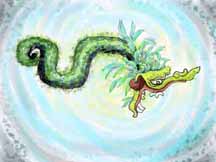
Chippewa Myth: The Great Serpent

Nanabozho was the hero of many legends told by the Chippewa Indians. He had just returned to his lodge where him and his cousin lived. His cousin was missing! As Nanabozho searched he came upon some tracks in the dirt, the Great Serpent seized his cousin. Immediately he retrieved his bow and arrow and set out to find this monster. Soon after he came to a deep, gloomy lake (now known as Manitou Lake) called Spirit Lake as well as Devil Lake. He then found the Great Serpents house at the bottom of the lake; it was filled with evil spirits who served him. Meanwhile, he saw the Great Serpent coiled around his cousins lifeless body. The Great Serpents head was blood red, he had fierce glowing eyes, and his body was armed with hard colorful scales. Nanabozho wanted revenge on this monster; in fact, he made the clouds go away, made the wind stop blowing, and the sun boil the water to make the Great Serpent slither out of the water. Then he could have his revenge on the monster who killed his cousin. Nanabozho changed himself into a stump as a disguise. Therefore the Great Serpent was furious. He created a flood, Nanabozho ran to the village and warned all the people. They all climbed up the biggest mountain to escape it. Nanabozho made a raft for him and all the people. Finally, the villiage people escaped the flood and found the Great Serpent to be dead, in other words they lived happily ever after!

Citation:
Crystal, Ellie. "The Great Serpent and the Flood." Native American Myths of Creation. 1995. 11 November 2008. .


Crystal, Ellie. "The Great Serpent." Painting. Native American Myths of Creation. 11 November 2008. <http://www.crystalinks.com/snakecreation.gif>

Thursday, October 30, 2008

Hero Quest


Hero: Journey, man/woman, something special, founder of something new, major flaw, universal (like everyone else).

Call to adventure: Task, given a goal or quest.

Companions and supernatural guide: Person that goes through the journey with the hero, someone close to them.

Initiation: Entry of strange world, First test.

Journey: Battles, tests, obstacles, challenges and temptations.

Ultimate test: The main and final battle, most important.

Transformation: Hero is altered in some way.

Death and Rebirth: Ressurection and return.

Boon: Something the hero shares with others, Treasure, spiritual, or psychological.

Friday, October 24, 2008

Definitions

A myth is someones belief of how things happen, usually made up. They symbolize human experience, embody spiritual values of a culture. An example is the story of Hercules.

A hero helps people, has qualities greater than human beings. An example of a hero is Hercules, he is a very well known hero.

A hero's journey is the story the hero goes through. The battles it goes though and what he/she accomplishes. The journey that Ra the sun god went on.

Universal is known by all, "one size fits all." Persephone has qualities that the common person could relate to.

Archetype is the original model of something. For Example, The Chinese explain how their world was created by the splitting of an egg.

Cyclical is a cycle, pattern, something that repeats itself. The cycle a myth goes through. For example every myth goes through this pattern.

Duality are two opposites existing in a whole. In Greek mythology the universe is an example of duality, heavens and underworld, or Zeus and Hades.

Creation is when someone or something is made, how it is created. An example is the egg, void or watery abis.

Life from death is something good coming from death of something bad. Sacrificing something for a life, something that dies in order for something else to live. For example the Chinese myth of PanGu. His body parts created the earth when he died.

Matriarchal is the foundation of female power: mother rules: mother earth. Rhea was considered the mother of the gods. Gaia was the earth, also considered "mother earth."

Patriarchal is the foundation of male power: father rules: father sky. Zeus is an example of patriarchal because he is the god of all the gods, ruler of the sky.

Sacrifice is giving up something for a greater god. Prometheus sacrificed his life and freedom for the better of the people.

Tuesday, October 14, 2008

Interpretation Essay

Hades and Persephone

Interpreting a myth takes a special kind of thinking. First step is taking it in on a basic level, how the myth explains something on a natural level. The story of Demeter and Persephone shows the changing of seasons. It then goes deeper and explains how they are interpreted socially, and finally how your mind takes them in and breaks it down psychologically. The story of Hades, Persephone and Demeter explains the changing of seasons, loss, grief and love.

In a natural way Hades represents everything that is evil, dead, rich and everything that has to do with the underworld. He is a thief, stealing Persephone from Demeter. He is a very lonely man, but who blames him, having to live alone in the underworld would not be the most social place, only having the non-living as a friend. He is very mysterious and unknown. All he really wants is companionship, which is why he travels up to earth to seek out Persephone for a partner.

Flowers, rain, beauty, innocence, these are a few things that depict Persephone. She is the only daughter of Demeter. She symbolizes purity, virgin, and new beginnings. Hades raped her of her innocence when he took her down to the underworld. At first, she was not content in the underworld but eventually she began to love Hades and liked living with him. It gave her a sense of belonging, she could figure out who she really was and wanted to be.

Demeter was in so much grief over the loss of her only daughter. Demeter is a very loving mother, goddess of corn. She is queen of the land, almost like Mother Nature. she is very nurturing. She signifies agriculture, food, earth and the seasons. She searched and search day in and day out for her loving daughter, prayed for her return. Nobody in Olympus would spread word of where she had disappeared. The day came and Demeter found out where Persephone had gone. Hades allowed Persephone to go back to the mortal world to visit her mother under one condition, she eat a pomegranate seed which would promise of her return. The seed was like a trap; it tied her to the underworld forever. Every four months she would come up and visit her mother. The seed was sweet, and delicious. It was tempting, juicy, and symbolized rebellion.

The story of Persephone and Demeter is important because it explains how seasons change. Persephone symbolizes spring, when she went to the underworld the earth was different. Then every four months she would arrive. Every four months a season changes, whether it be spring, winter, summer or fall. I assume it was her job on earth.